|
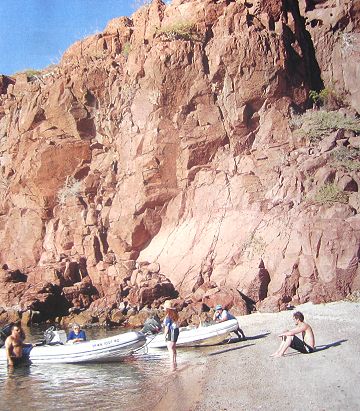
Boaters wade ashore to beachcomb on a sandy shore in the Sea of Cortez. Few people seem to use Baja beaches.
from Seattle, and Joyce invited friends aboard for a preseason cruise.
Our goal was to motor north of La Paz among a chain of islands strong along the east shore of the peninsula. But first we needed dinner and groceries for the week.
Bill led us to a small restaurant near the marina, where we loaded tortillas with carne asada (bite-size pieces of marinated beef cooked outdoors) and with onions, tomatoes, salsa, cucumbers, and other good things I didn't recognize. A Pacifico cerveza was just right.
At City Club, which looks and works like a Costco store, we spent thousands of pesos on food, but in Yankee terms it came to about $400. Most impresive were the huge lesh bags of limes and avacodos we carried from the store. Emily Wwchak, who holds a master's degree in fisheries biology and usually works as kayak master and naturalist on Ursa, was doubling on this trip as deckhand and chef (and she made the best guacamole I've ever tasted.)
As we lined up a string of marina dock carts to haul the groceries to the boat, I thought about our destination for the next day: either Isla Partida or its close neighbor, Isla Espiritu Santo. Ursa's crew and guidebook promised several good anchorages, sweeping, sandy beaches and a tumbled, colorful array of striated rock, the result of tectonic plate shifting and eons of weathering and volcanic activity. The islands are 20-plus miles north of La Paz, about three hours running at displacement speeds.
Isla Espiritu Santo is the first in a chain of widely scattered islands leading toward the town of Loreto, about 120 miles north of La Paz. Cruisers and sailors push beyond to Punta Conception and other small islands and anchorages in Baha Concepcion. For many, Santa Rosalia, about halfway up the Baja coast, is the end of the line. It also is a jumping off print for boaters making the long crossing
|
of the Sea of Cortez to San Carlos or Guaymas on the Mexican mainland.
Because our time was limited, we would cruise only to Isla San Francisco, 44 nautical miles north of La Paz. That was the plan. But we didn't get there.
Next morning, both trawlers were getting ready to leave port. Engines were warming and gear was being stowed. On Ocean Quest, Bill followed his usual departure checklist and tested gears. The big yacht moved gently asstern against her mooring lines as he engaged the variable-pitch propeller. He moved the controller to forward - and nothing happened. Although the hydraulic controller had been removed and rebuilt during the restoration, Bill suspected it was the problem.
The device, in the bilge beneath the master stateroom, weighs an estimated 200 lb. Bill knew the system well, but he needed assistance. In a response typical of the cruising community, Josh Haury, skipper of Ursa Major, went to help. He was joined by a temporary Ursa crew member, John Love, a U.S. Ski Team hopeful and a licensed skipper who operates a family-owned charter yacht on Alaska's Prince William Sound in the summer.
They removed the controller and hauled it up a steep stairway to the main deck, then out to the mooring float. The problem, apparently a stuck piston, was corrected, and the heavy chunk of steel was carried back aboard and installed.
It worked. The job sounds simple, but it took about 12 hours, start to finish. Although La Paz has a boatyard and engine technicians. I doubt Bill would have found anyone in town who shares his knowledge of the complex, variable-pitch European-built propeller and controller, both original equipment and nearly a half century old. Self-sufficiency is the most valuable thing a boater can take cruising.
WHERE'S THE WIND?
We were ready to pull our mooring lines aboard the next morning and head north. But first we had to check the weather.
When I cruise the Inside Passage, my morning ritual seldom changes. First, switch on the VHF radio and dial in the appropriate channel for weather forecasts and conditions (NOAA in the United States; Environment Canada in British Coloumbia). Next, start heating water
|


